How Many Carbon Monoxide Detectors Do You Need in Ottawa?
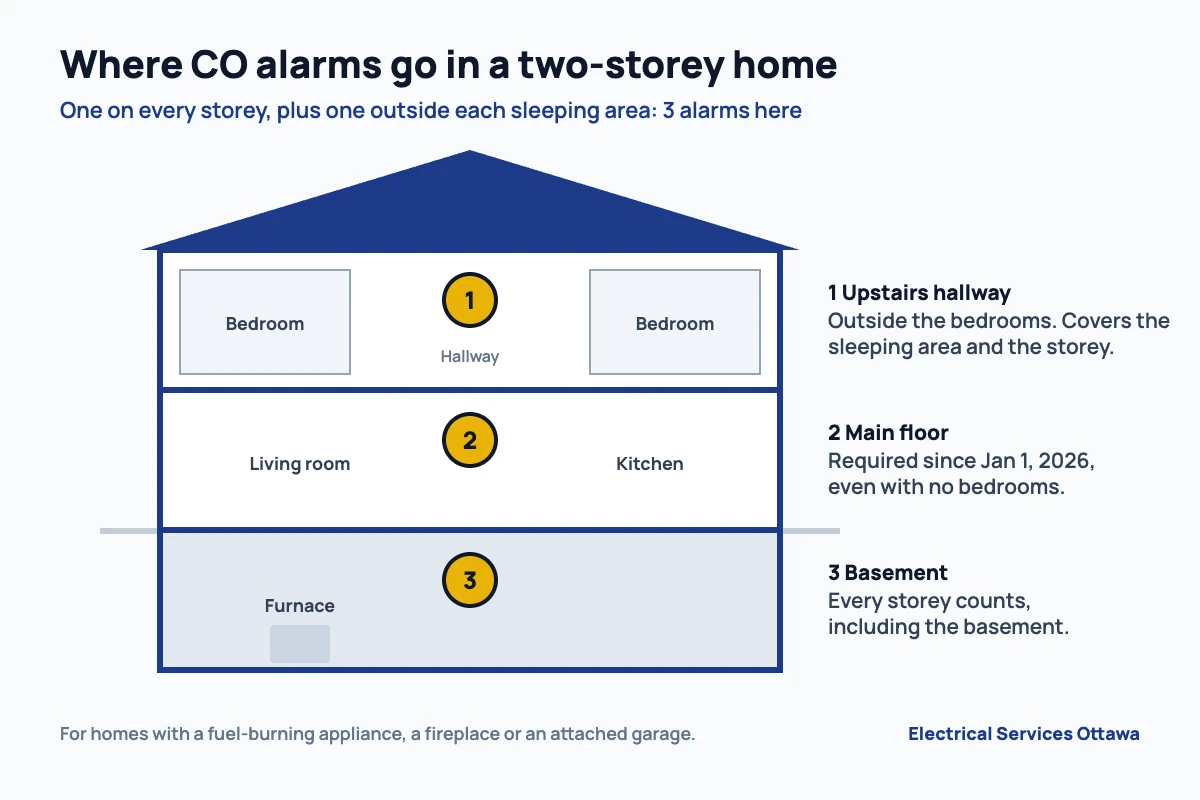
Most Ottawa homes need a carbon monoxide (CO) alarm on every storey, basement included, plus one outside each sleeping area. The rule covers any home with a fuel-burning appliance, a fireplace or an attached garage, and the every-storey part has been in Ontario’s Fire Code since January 1, 2026. For a two-storey house with a basement and all the bedrooms upstairs, that means at least three alarms.
Key takeaways
- Homes with a gas or oil furnace, a gas water heater, a gas stove, a wood stove, a fireplace or an attached garage must have CO alarms.
- Put one alarm outside each sleeping area and one on every storey, including the basement and floors without bedrooms.
- For existing homes, certified battery, plug-in and hardwired alarms all meet the Fire Code.
- In a rental, the landlord installs, tests and maintains the alarms.
- If a CO alarm sounds, get everyone out and call 911 from outside.
Is every house in Ottawa required to have a carbon monoxide detector?
No. The rule covers homes with a fuel-burning appliance, a fireplace or an attached garage, and homes heated by air from a fuel-burning appliance outside the home. That takes in most Ottawa houses, since gas furnaces, gas water heaters and attached garages are common here.
A fully electric home with no fireplace and no attached garage falls outside the CO rule. It still needs working smoke alarms on every storey and outside all sleeping areas.
How many carbon monoxide detectors do you need?
Count one alarm for every storey, then add one for each sleeping area that the storey’s alarm doesn’t already sit beside. An alarm in the hallway outside the bedrooms covers both rules for that floor.
| Home layout | Minimum CO alarms |
|---|---|
| Bungalow with a basement, bedrooms on the main floor | 2 |
| Two-storey house with a basement, bedrooms upstairs | 3 |
| Two-storey house with a basement, bedrooms upstairs and one in the basement | 3, with the basement alarm outside that bedroom |
| Bedrooms in two separate wings on one floor | One outside each wing, plus one on every other storey |
Storeys without bedrooms count too. Before 2026, many Ottawa homes had a single detector near the bedrooms or the furnace, and that setup no longer meets the rule.
Where should CO detectors go?
Put each alarm in the hallway or area just outside the bedrooms, and give every other storey its own alarm in a central spot. Mount each one at the height and spacing in the manufacturer’s instructions, because models differ.
When we install hardwired alarms, we place each unit based on the home’s layout and the manufacturer’s rules.
Rules for apartments, condos and rentals
A unit needs CO alarms if it has a fuel-burning appliance or fireplace, sits directly above, below or beside a garage or a service room with fuel-burning equipment, or is heated by air from an appliance outside the unit. Inside the unit, the same placement applies: next to each sleeping area and on every storey. Since January 1, 2026, public corridors heated by air from a fuel-burning appliance need alarms too.
In a rental, the landlord installs and maintains the alarms and gives tenants the maintenance instructions. The landlord also tests them every year, whenever batteries are replaced, when the electrical circuit changes and when tenants change. Tenants report any alarm problem to the landlord, and removing batteries or tampering with an alarm is against the law for anyone.
If you are adding a legal basement suite, plan the alarms for both units as part of the electrical work.
Do CO detectors need to be hardwired?
No. For existing homes, Ontario’s Fire Code accepts certified hardwired, battery-operated and plug-in CO alarms, and many homes use combination smoke and CO units. New builds and major renovations can have extra Building Code requirements. You can put up battery and plug-in alarms yourself, following the manufacturer’s instructions.
For a multi-storey home, compatible hardwired, interconnected alarms are a practical choice. When one detects CO, the connected alarms sound throughout the home, so an alarm in the basement wakes everyone upstairs. Models with battery backup keep working during a power outage, as long as the backup battery is good. Adding a wired alarm in a new spot is electrical work that needs an ESA notification, and we file it as part of the job.
Replacing an existing hardwired alarm typically runs $80 to $150 per unit with us, and adding a wired alarm in a new location $150 to $250. A whole-home set of 6 to 8 interconnected smoke and CO alarms typically runs $600 to $1,500.
Is 70 ppm too high? What a CO alarm is telling you
Yes. A CO alarm responds to both the amount of carbon monoxide in the air and how long it stays there. Home alarms are tested to sound within 1 to 4 hours at 70 ppm, 10 to 50 minutes at 150 ppm, and 4 to 15 minutes at 400 ppm, and some models also show lower readings. These are alarm test points, not a guide to how much CO is safe to breathe, so treat every alarm as an emergency.
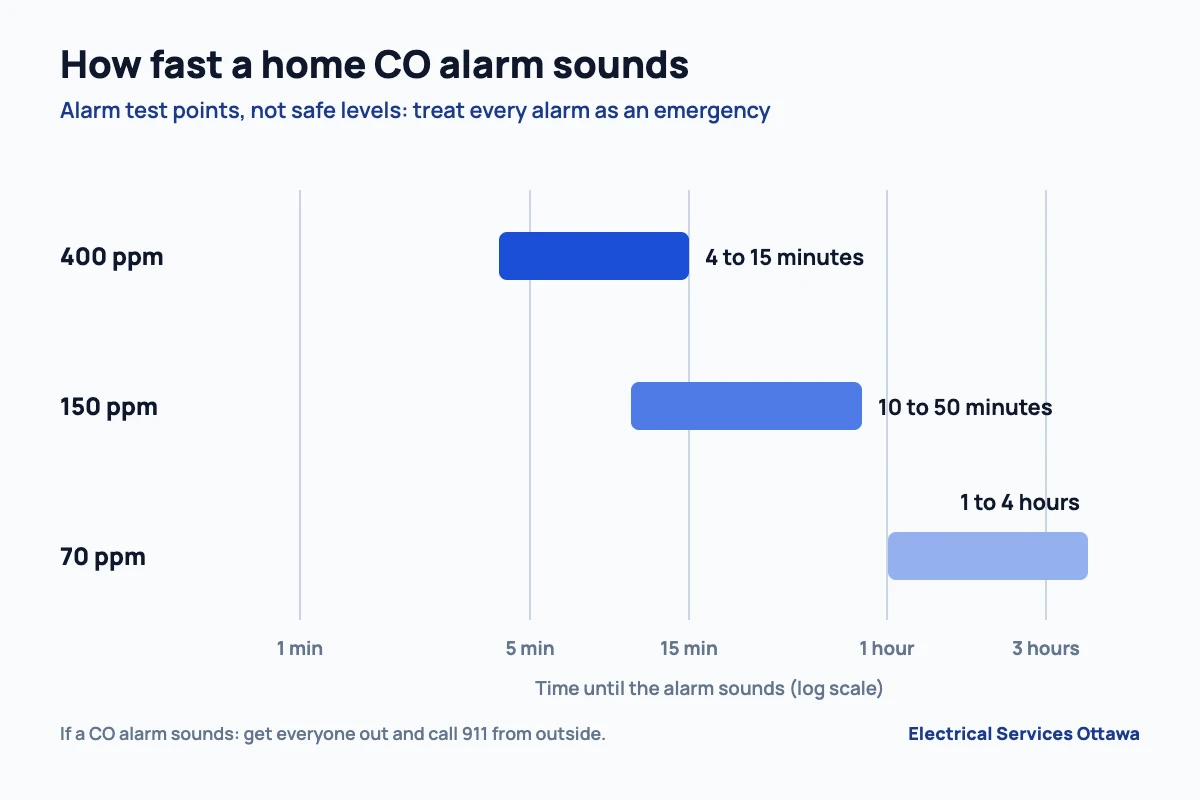
If the alarm sounds, get everyone out right away and call 911 from outside. Signs of CO poisoning include headaches, nausea, dizziness, confusion and drowsiness. Stay outside until responders tell you it is safe to go back in.
How to test and replace CO alarms
Press the test button once a month. If your alarm has replaceable batteries, change them every year or as the manufacturer directs; sealed-battery models follow their own schedule. Replace the whole alarm by the date printed on it, since new batteries don’t extend that date.
Learn the three sounds your model makes: the low-battery chirp, the end-of-life warning and the full emergency alarm. The manual and the label on the back explain each one. A chirp that continues after a new battery usually means the alarm has reached end of life and needs replacing.
FAQ
Does the rule apply to older Ottawa homes?
Yes. The Fire Code applies to existing homes, not just new builds, as long as the home has a fuel-burning appliance, a fireplace or an attached garage.
Do I need a CO alarm if my only gas appliance is the stove?
Yes. A gas or propane stove is a fuel-burning appliance, so the home needs CO alarms outside each sleeping area and on every storey.
Who can confirm what my home needs?
Your local fire department, which in Ottawa is Ottawa Fire Services. They can answer questions about the requirements for your specific home.
Get your CO alarms up to the 2026 rule
Electrical Services Ottawa installs hardwired, interconnected smoke and CO alarms in homes across Ottawa, placed to meet the every-storey rule. See our smoke and CO detector installation page, or call (343) 459-3141 for a written quote.